



Energy.
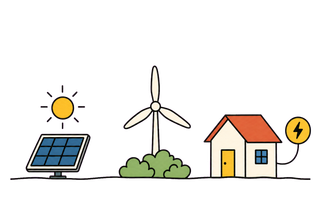
Electricity, heat, storage, cooking energy, and microgrids.
Where automation could bite — and what stays visible.
What it includes
Electricity, heat, storage, cooking energy, and microgrids.
The opportunity
Solar, batteries, load management, microgrid planning, inspection, and maintenance.
The guardrail
Use full lifecycle and local-grid assumptions; no single-number savings promises.
Roadmap status: Focus — one of the three first-phase sectors, with Shelter and Energy. Status is sequencing, not importance.
No number ships without a receipt.
Research and analysis for this sector hasn’t started yet. When the first figures are ready they’ll appear here — each with its source, date, region and confidence label.
A worked example: a neighbourhood's electricity bill.
Measure
Measure — start with what a household actually pays for electricity and heat in one region, from public data with the date and region attached.
Publish
Publish — put the sources and the assumptions up before the conclusions, so anyone can check the starting point.
Break down
Break down — separate the bill into generation, grid and delivery, fuel, and peak demand. Establishing the real split is the work, not the assumption.
Match
Match — ask which parts a named mechanism could move. Shared solar with batteries and load management, planned as a microgrid, could reduce fuel and peak costs. It also carries capital, inspection and maintenance costs across its full lifecycle. Both sides get counted, on local-grid assumptions, with no single-number savings promise.
Package
Package — publish the model, the sources, a brief and a playbook, so a community energy group, co-op or public body can run it. Uncost does not operate the microgrid.
Track
Track — follow whether the total cost actually falls where the model is applied. Where the lifecycle cost outweighs the saving, that result gets published with the same prominence as a win.
“Use full lifecycle and local-grid assumptions; no single-number savings promises.”
Where Energy shows up in The Projects.
| ID | Project | Role for Energy | Status |
|---|---|---|---|
| PRJ-001 | Human Essentials Dashboard — Presents what energy costs by region, with sources and history. | Presentation layer | Draft — not approved for build |
| PRJ-002 | Cost-of-Living Tracker — Supplies the energy price data: sourced, dated, licensed, and refreshed on a published schedule. | Data layer | Draft — not approved for build |
| PRJ-003 | Basic Needs Cost Model — Tests where automation can genuinely reduce energy costs. | Scenario layer | Draft — not approved for build |
| PRJ-004 | Community Resource Simulator — The Community Resource Simulator lets a neighborhood, co-op, or campus honestly compare what shared solar, a tool library, or community growing would plausibly change for them — with assumptions shown, ranges instead of promises, and a clear list of what a real feasibility study would still need to verify. | Primary sector | Draft — not approved for build |
| PRJ-006 | Automation Dividend Study — The Automation Dividend Study asks a simple question with published methods and sources: when AI and robotics make things cheaper to produce, do the essentials of life get cheaper to buy — and under what conditions has that actually happened? | Primary sector | Draft — not approved for build |
| PRJ-007 | Basic Needs Planner — The Basic Needs Planner helps a group exploring a community site or initiative turn their context into a structured draft plan — what capacity they'd need, what data they're missing, what risks to register, and exactly which professionals to engage next. | Primary sector | Draft — not approved for build |
The register comes before the figures.
Every source Uncost uses gets a public ID, publisher, date, license, refresh cadence, and region coverage. The Energy dossier draws on the register as reviewed records are added.
Keep reading.
Help build the energy evidence.
Sources before slogans.
Early useful roles: source and license review, data methodology, sector research, and — as the work grows — a volunteer Energy sector lead.